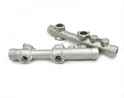

Anyone involved in the foundry business knows that certain issues can be a real headache. For instance, a complex casting might need to fit *perfectly* against an assembly surface, yet no matter how carefully you measure it with a manual caliper, the results never seem quite accurate. Or perhaps a batch of castings has already gone through machining, only for you to discover they don't match the engineering drawings-leading to endless arguments over whether the fault lies with the raw casting blank or the machining process itself.
Now, thanks to 3D laser scanning, these problems are no longer so complicated.
What exactly does it do?
Simply put, you take a scanner-either handheld or mounted on a tripod-and "sweep" it over the casting. This process captures data with an accuracy ranging from 0.02 to 0.05 millimeters. Once the scan is complete, the computer generates a 3D digital model that is an exact replica of the physical object. You can then compare this model against the original design drawings to identify any discrepancies-areas where there is excess material, where material is missing, or where the geometry is misaligned. By applying a color-coded deviation map, these issues become crystal clear: red areas indicate excess material, while blue areas indicate a shortage.
You don't need to be a technical expert to understand the results.

Where can it be applied?
Here are four of the most common examples:
1. Mold Verification: Once a mold has been manufactured, it can be scanned and compared against the 3D design data. This allows you to verify its accuracy and identify any areas requiring adjustment-whether at the wooden pattern or metal mold stage-so that corrections can be made *before* any castings are poured, preventing issues from surfacing later.
2. Casting Blank Inspection: This is particularly useful for castings with complex geometries or uneven wall thicknesses, which are impossible to fully measure using standard calipers. A single scan reveals the complete distribution of machining allowance across the entire surface; you can instantly see where the allowance is insufficient or where the material is excessively thick, providing a solid foundation of confidence for subsequent machining operations.
3. Machining Datum Alignment: For large or deformed castings, significant effort is often required to establish proper leveling and centering before mounting them on a machine tool. By using scanning to quickly generate a digital model of the physical part-and then simulating the clamping and machining processes-you can identify the optimal machining position on the computer *in advance*, thereby drastically reducing the setup and auxiliary time required on the machine tool itself.
4. Casting Repair and Reverse Engineering: For older castings where the original drawings have been lost, or for castings requiring material buildup or weld repairs, scanning provides a complete set of 3D data. This data serves as a reliable foundation for subsequent steps, whether that involves manufacturing a new mold or generating CNC machining programs.
Is it expensive? Is it difficult to use? Currently, there are numerous companies in China offering third-party scanning services. Scanning a medium-sized casting typically costs only a few hundred to a couple of thousand yuan-a far more cost-effective approach than relying on repetitive trial cuts or risking the production of scrap parts. Operationally, there is no need for you to purchase equipment or hire additional personnel; simply ship the casting to the service provider, and they will deliver a comprehensive inspection report and 3D data directly to you.
In summary
3D laser scanning is essentially a tool for "digitizing physical objects," enabling you to move away from relying on guesswork based on experience and, instead, let data speak for itself. Whether for casting inspection, mold acceptance, or machining alignment, this technology helps you save time, minimize errors, and reduce costs. If your products demand high precision, feature complex geometries, or frequently give rise to dimensional disputes, this method is certainly worth a try.