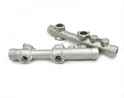

Brass Investment Casting
The working principle of the spiral nozzle of brass investment casting: after the liquid (or slurry) is tangent and collided with the continuously smaller helical surface, it becomes tiny liquid droplets and sprays out to form a mist. The streamlined design from the inlet to the outlet in the nozzle cavity reduces the resistance coefficient to a lower level, does not block, the material is corrosion-resistant, the atomization effect is good, and the use is convenient, so the spiral nozzle is suitable for various positions. For example: chemical industry, environmental protection, electric power, textile and many other industrial fields, especially the flue gas desulfurization and dust removal industry is the most widely used. Its corrosion resistance, fogging properties and anti-blocking properties have been accepted by many users in the industry.
Features of all-silica medium-temperature wax investment casting: 1. It can cast complex castings of various alloys, especially difficult-to-machine materials such as high-temperature alloys and stainless steel. 2 Brass investment castings have high dimensional accuracy and surface finish, generally up to CT4-6, only leave a little machining allowance on the parts with higher requirements, and even some castings only leave grinding and polishing allowances , can be used without machining.
Non-investment casting is usually used for casting of stainless steel, carbon steel, alloy steel, brass and other materials. Brass investment cast stainless steel is common: 304 cast stainless steel 316 cast stainless steel 420 cast stainless steel 440 cast stainless steel 630 cast stainless steel.
Melting points in investment casting of brass alloys: increasing the melting temperature of the metal will increase its vapor pressure and volatilization loss accordingly. In actual production, generally, the higher the melting temperature, the longer the time, the more volatile elements, the lower the pressure in the furnace, the larger the surface area of the molten pool, and the worse the covering conditions, the greater the volatilization loss. Aluminum, beryllium, etc. form a protective oxide film on the surface of the molten pool, which can significantly reduce the loss of volatile components in the alloy. Brass investment casting and smelting equipment has a greater impact on metal volatilization. Generally, induction furnaces have less volatilization losses, while reverberatory furnaces have greater losses.
The characteristics of the four shell-making processes of brass investment casting:
1 Brass investment casting water glass shell: This process has a production history of nearly 50 years in China. After half a century of unremitting efforts by colleagues in the brass investment casting industry, the application and research of the water glass shell process has reached a high level. Over the years, due to the improvement of the back layer shell refractory material and the popularization and application of new hardeners, the strength of the water glass shell has been doubled. Low cost, short production cycle, excellent shelling performance and high air permeability are still the advantages that any other shelling process can't reach so far.
2 Brass investment casting compound shell: Compared with the water glass shell, the surface quality of the casting has been greatly improved, the surface roughness is reduced, the surface defects are reduced, and the repair rate is reduced. It can be applied to high alloy steel such as stainless steel and heat-resistant steel. The production cycle is much shorter than that of the low temperature wax-silica sol mold, and is similar to the water glass mold.
3 Brass investment casting silica sol (low temperature wax) shell: This process is in line with national conditions, and has the greatest adaptability and superiority when casting more than 1kg, especially more than 5kg castings. Compared with the composite shell, the quality is more stable, especially the casting has high dimensional accuracy, because it has no water glass, and the shell has good high temperature performance. Thin-walled parts, small and medium-sized parts with complex structure, and extra-large parts weighing 50-100kg, such as water pumps, impellers, guide casings, pump bodies, ball valve bodies, valve plates, etc. For thin-walled small, medium or large parts, fork shells or lift shells can be used for direct casting in front of the furnace, which guarantees a high yield.
4 Brass investment casting medium temperature wax full silica sol shell: This is a common precision casting production process on the machine. It has high casting quality and low repair rate, especially suitable for high surface roughness requirements and dimensional accuracy. High, medium and small pieces and extra small pieces (2-1000g). However, due to equipment and cost constraints, it is less used (5-100kg).