

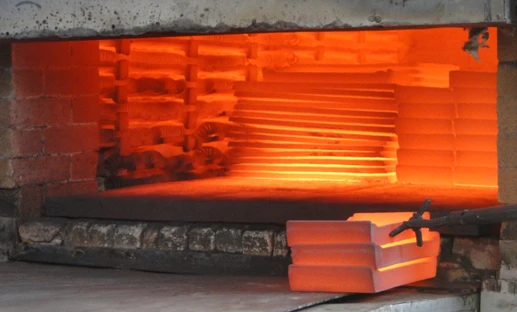
Shandong WABON is equipped to perform heat treatment processes on its products. Heat treatment is a metalworking process involving the heating, holding (soaking), and cooling of metal materials within a specific medium. By altering the metallographic structure-either at the surface or within the interior-of the material, this process allows for precise control over its mechanical properties.
Different products require different heat treatment processes; let us explore the distinctions between them.
Annealing
Annealing involves slowly heating a metal to a specific temperature, holding it at that temperature for a certain period, and then allowing it to cool slowly back down to room temperature.
Primary Functions
- To reduce hardness and improve machinability.
- To relieve internal stresses.
- To enhance plasticity and toughness.
- To improve structural uniformity.
Simply put: Annealing is the process of "making the material softer and easier to machine.
Normalizing
Normalizing involves heating a metal to a temperature approximately 30–50°C above its critical temperature.
After holding the metal at this temperature for an appropriate duration, it is allowed to cool in open air. At first glance, normalizing appears quite similar to annealing. However, the cooling rate in normalizing is slightly faster, resulting in a shorter production cycle. This is because normalizing utilizes external forces-such as fans-to accelerate the cooling process, thereby allowing for the quicker production of finished parts. Consequently, whenever both annealing and normalizing can effectively meet the required performance specifications for a component, normalizing is generally the preferred choice.
Quenching
Quenching involves heating a metal above its critical point, a process that triggers a transformation in the metal's internal structure and state-specifically, austenitization. The metal must be held at this temperature for a specific duration to allow this transformation to complete. Subsequently, it is cooled at a rate exceeding its critical cooling velocity to produce a metastable martensitic structure or a lower bainitic structure. This rapid cooling method results in a martensitic microstructure; however, the internal structure of this state is highly unbalanced. Furthermore, the material exhibits high brittleness. Consequently, a metal that has undergone quenching alone cannot be shipped as a finished product-no customer would accept it in such a state. This is precisely where the critical role of tempering comes into play!
Tempering
Tempering is a heat treatment process performed *after* a metal has been hardened (quenched). It involves reheating the metal to a specific temperature *below* its critical point and holding it there for a certain period to allow the internal microstructure to redistribute and homogenize. Finally, the metal is cooled back down to room temperature. The result is a finished product that possesses a balanced combination of strength and hardness, alongside adequate plasticity and toughness. Ultimately, heat treatment serves as a vital quality assurance measure for manufactured products.