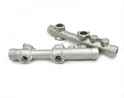

Precision casting (also known as near net shape casting) is a casting technology with high precision, low machining allowance, and complex shape forming as its core advantages, covering process types such as investment casting, lost foam casting, and shell casting. Its core feature is the ability to directly produce metal components with high dimensional accuracy, low surface roughness, and complex structure, without the need for extensive subsequent mechanical processing to meet assembly requirements.
As the core equipment of modern agricultural production, agricultural machinery works under harsh conditions such as soil wear, moisture corrosion, and heavy load impact for a long time. At the same time, it has extremely high requirements for the accuracy consistency, reliability, and mass production adaptability of its components. Precision casting, with its advantages of flexible material selection, strong forming ability, and stable performance, has become one of the core technologies for manufacturing key components of agricultural machinery. It is widely used in multiple systems such as power transmission, tillage operations, hydraulic control, and harvesting processing.
The core components of agricultural machinery need to meet the four major requirements of "wear resistance, impact resistance, high precision, and easy assembly" simultaneously. Precision casting, through material customization and molding process optimization, perfectly adapts to the functional requirements of different components:
1. Power transmission system components (core load-bearing class)
The power transmission system is the "heart" of agricultural machinery, responsible for transmitting engine power to the walking and operating mechanisms. Components need to withstand high-strength loads and impacts, with strict requirements for dimensional accuracy and mechanical performance.
Typical components: gearbox housing, differential housing, gears, shaft sleeves, power output shaft flange, etc.
Material selection: Alloy steel (20CrMnTi, 40Cr), ductile iron (QT450-10, QT600-3), and some high-end agricultural machinery uses aluminum alloy.
Application advantages: The transmission, differential housing, and other structures are complex (including multiple sets of bearing seats and oil passages), and traditional casting requires a large amount of cutting and processing. However, lost foam casting or shell casting can form the internal cavity and installation surface in one go, reducing machining allowance and improving assembly accuracy; Gears, shaft sleeves and other transmission components are integrated into complex structures such as tooth profiles and shaft shoulders through investment casting, with better grain uniformity than forging, improving impact resistance and effectively avoiding tooth surface cracking under heavy loads.
Actual value: After a certain tractor brand adopts precision casting of the gearbox housing, it reduces assembly errors, improves power transmission efficiency, and reduces housing failure rates.
2. Cultivation and sowing components (wear-resistant operations)
The components of tillage (plow, rake, subsoiler) and sowing (seeder, transplanter) come into direct contact with the soil and seeds, facing severe wear and soil corrosion, while ensuring operational accuracy (such as sowing spacing and trenching depth).
Typical components: plowshare, rake blade, deep loosening shovel, seeder chamber/impeller, trencher, seeding disc, etc.
Material selection: High chromium cast iron (Cr15-20), wear-resistant alloy steel (NM450), stainless steel (304), and some key components are cast using bimetallic composite casting (wear-resistant layer+ductile matrix).
Application advantages: Components such as plows and deep loosening shovels require complex curved surfaces to reduce soil resistance. Precision casting can accurately form curved structures, combined with the wear-resistant properties of high chromium cast iron, resulting in a 2-3 times longer service life than traditional casting; Precision components such as the seeder impeller and seeding disc are achieved with a 0.05mm dimensional accuracy through investment casting, ensuring uniform seed drop and improving seeding qualification rate.
Actual value: After using investment casting for the seeding chamber of the corn planter, the seed jamming rate is reduced, and the sowing error per mu is controlled within ± 3%, meeting the needs of precision agriculture.
3. Hydraulic and control system components (precision control category)
The hydraulic system is the "neural network" of agricultural machinery, responsible for controlling the movement, lifting, and steering of the operating mechanism. Its components must meet the requirements of sealing, pressure resistance, and precise action.
Typical components: hydraulic valve body, valve core, cylinder body, hydraulic joint, distributor housing, etc.
Material selection: Aluminum alloy (6061, A356), stainless steel (316L), ductile iron (QT500-7).
Application advantages: The internal oil circuit of the hydraulic valve body is complex and the aperture is small (with a minimum aperture of 3-5mm). Investment casting can accurately form the oil passage, with a surface roughness Ra ≤ 3.2 μ m, and no additional boring is required to meet the sealing requirements; The cylinder body made of aluminum alloy material is lightweight through precision casting, reducing energy consumption of agricultural machinery.
Actual value: After precision casting, the hydraulic distributor housing of the combine harvester reduces oil leakage failure rate and improves control response speed.
4. Harvesting and processing components (impact resistant)
The harvesting components of combine harvesters, crushers, and other equipment need to handle crop straw and seeds, which face high-frequency impact and wear. The structure is mostly irregular tooth shaped and cavity shaped.
Typical components: threshing drum teeth, cleaning screen frame, crusher hammer seat, straw returning machine blade seat, etc.
Material selection: wear-resistant steel (Mn13), alloy cast iron (HT250+Cr), bimetallic composite casting material.
Application advantages: The teeth of the threshing drum are formed by investment casting to achieve integrated tooth profile, and the tooth surface hardness can reach HRC55-60, improving the ability to resist impact wear; The cleaning screen frame is formed by lost foam casting to avoid welding deformation, ensure the accuracy of screen installation, and improve cleaning efficiency.
Actual value: After precision casting, the threshing drum teeth of the corn combine harvester have been extended from 800 hours to 1500 hours, reducing the frequency of downtime and replacement.
5. Auxiliary system components (adapted to the environment)
The components of agricultural machinery auxiliary systems (irrigation, heat dissipation, exhaust) need to adapt to outdoor humid and corrosive environments, while pursuing fluid dynamic efficiency or heat resistance.
Typical components: irrigation pump impeller, pump housing, exhaust pipe, radiator bracket, etc.
Material selection: corrosion-resistant alloy (2Cr13), cast iron (HT200), aluminum alloy.
Application advantages: The impeller of the irrigation water pump is precision cast, with smooth and burr free flow channels, improving hydraulic efficiency and reducing energy consumption; The exhaust pipe adopts a complex bending structure through shell casting, with better heat resistance than welded parts, and is suitable for the high-temperature exhaust environment of the engine.