


Lost-waste casting (investment casting), with its advantages of high precision and complex structure forming, has become one of the core manufacturing processes for high-end inserts. It has wide material adaptability, allowing for the matching of different metal materials with different properties according to the working scenario of the insert (such as precision cutting, heavy-duty crushing, outdoor operations, etc.), ultimately ensuring the durability and efficiency of the insert. The following are the mainstream suitable materials and industry application characteristics of lost-waste casting inserts.
I. Alloy Tool Steel: The Mainstream Choice for Mid-to-High-End Inserts
Alloy tool steel is a commonly used material for lost-waste casting inserts. By adding alloying elements such as chromium, molybdenum, and tungsten, it balances hardness and toughness, making it suitable for most general-purpose applications. Among them, chromium-molybdenum alloy steel has strong wear resistance and impact resistance, making it suitable for manufacturing heavy-duty inserts such as forestry logging tools and mining crushing tools; tungsten-molybdenum alloy steel has excellent high-temperature stability and can be used for metal cutting inserts, able to withstand the high-temperature wear during cutting. Lost-waste casting can precisely control the forming accuracy of these materials, reducing performance damage caused by subsequent processing, and is especially suitable for manufacturing inserts with complex cutting edges or chip grooves.
II. High-Speed Steel: The Core Material for Precision Cutting Inserts
High-speed steel (such as W18Cr4V) possesses extremely high hardness, wear resistance, and red hardness. It is less prone to edge dulling during high-speed cutting, making it a core material for precision cutting inserts. It is widely used in machining, mold manufacturing, and other fields. Lost-wax casting allows for the formation of complex structures in high-speed steel inserts and enables precise control of the material melting process, reducing internal porosity, inclusions, and other defects, ensuring the precision and consistency of the insert's cutting edge. For standardized precision cutting inserts requiring mass production, the combination of high-speed steel and lost-wax casting balances performance and production efficiency.
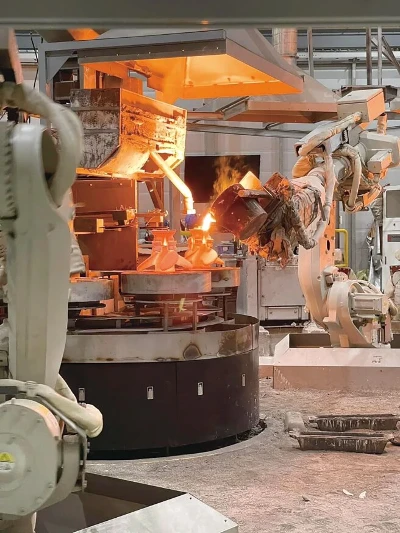
III. Carbide and Composite Materials: The Exclusive Choice for High-End Wear-Resistant Applications
Carbide (such as WC-Co series) has a hardness far exceeding that of tool steel and extremely high wear resistance, but relatively poor toughness. Through the composite forming technology of lost-wax casting, a combined structure of "carbide cutting edge + alloy steel matrix" can be achieved-the cutting edge ensures extreme wear resistance, while the matrix provides sufficient toughness, perfectly suited for cutting hard metals, stone, and other demanding applications. Furthermore, some high-end cutting tools utilize stainless steel (such as 3Cr13), employing lost-wax casting to achieve a corrosion-resistant structure, making them suitable for humid and multi-medium working environments and preventing the tool's lifespan from being reduced due to rust.
In summary, the material selection for lost-wax casting cutting tools must be closely aligned with the operating conditions. From the versatility of alloy tool steels and the precision cutting capabilities of high-speed steels to the high-end wear resistance of cemented carbide composite materials, a complete material compatibility system has been formed. The excellent compatibility of the lost-wax casting process with various materials, as well as the precise control over forming accuracy and material uniformity, provides a core guarantee for the performance of cutting tools in different scenarios, driving the development of cutting tool manufacturing towards a more specialized and efficient direction.
