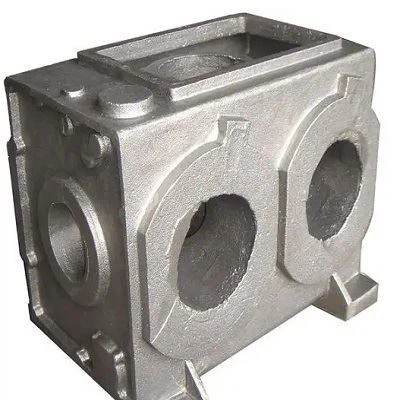


CNC machined castings combine the near-net-shape advantages of investment and sand casting with the dimensional accuracy of 4-axis and 5-axis CNC machining. This process eliminates excess material weight while achieving tight-tolerance functional surfaces, critical bore alignments, and complex internal flow channels.
Primary Casting Processes: Investment Casting (Silica Sol and Water Glass), Resin Sand Casting, Shell Mold Casting
Machining Precision: Dimensional tolerance down to +/-0.005 mm; Surface finish up to Ra 0.8 um
Part Weight Range: 0.1 kg to 500 kg
Annual Capacity: Over 15,000 metric tons across steel, iron, and alloy components
Industry Compliance: ISO 9001:2015, IATF 16949, ASTM, DIN, EN, JIS standards
Manufacturing Process
To eliminate internal porosity before final machining, every casting batch follows a controlled metallurgical and mechanical workflow:
Pattern and Mold Design: Simulation of metal flow and solidification via MAGMASOFT to prevent shrink defects.
Casting and Pouring: Induction melting under pyrometer temperature control.
Heat Treatment: Annealing, normalizing, quenching, or tempering to achieve required mechanical properties.
Rough Machining: Removal of scale, risers, and excess stock to establish datum planes.
Precision CNC Machining: Boring, milling, threading, and turning on high-rigidity CNC centers.
Surface Finishing: Blasting, passivation, plating, or powder coating per customer specification.
Materials and Technical Specifications
|
Material Class |
Grade / Standard |
Key Mechanical Properties |
Typical Applications |
|
Stainless Steel |
304 / 316 / 316L / 1.4408 |
Tensile: >=520 MPa Yield: >=205 MPa |
Pump housings, valve bodies, marine hardware |
|
Duplex Stainless Steel |
2205 (UNS S31803) / 1.4462 |
Tensile: >=655 MPa PREN: >=34 |
Desalination, offshore chemical processing |
|
Carbon Steel |
WCB, LCC, 1045, 4140 |
Tensile: 485-655 MPa Impact: >=27J at -40 deg C (LCC) |
Structural brackets, heavy equipment lugs |
|
Ductile Iron |
QT450-10, QT500-7, GGG40 |
Tensile: >=450 MPa Elongation: >=10% |
Hydraulic manifolds, steering knuckles |
|
Gray Iron |
HT250, HT300, GG25 |
Tensile: 250-300 MPa Damping Capacity: High |
Engine blocks, machine tool bases |
Key Product Features
Integrated Datum Accuracy:
Machining directly from cast-in datums ensures concentricity between raw cast features and precision-bored holes.
Controlled Porosity:
Ultrasonic and X-ray testing verify internal soundness prior to machining, preventing tool breakage and sealing failures under pressure.
Complex Geometry Execution:
5-axis machining enables complex impeller vanes, fluid ports, and thin-wall configurations without multi-setup accumulative errors.
Traceable Metallurgy:
Spectrographic analysis per heat lot, with full chemical and mechanical certification (EN 10204 3.1).
Typical Applications
High-pressure valve bodies, centrifugal pump impellers, filter housings, manifold blocks.
Planetary gear carriers, excavator suspension links, hydraulic cylinder mounts.
Steering knuckles, brake calipers, turbocharger housings, flywheel covers.
Steam turbine brackets, wind turbine lock plates, burner nozzles.
Machining and Secondary Operations
CNC Machining Capabilities
• 4-Axis and 5-Axis Horizontal/Vertical Machining Centers: Envelope up to 1500 mm x 1200 mm x 1000 mm
• CNC Turning Centers: Turning diameter up to 800 mm, length up to 1500 mm
• Precision Boring and Threading: Thread pitch accuracy to Class 6H/6g; Deep-hole boring capability
Surface and Finishing Treatments
• Shot Blasting (Sa 2.5)
• Electropolishing and Passivation (Stainless Steel)
• Zinc-Nickel Plating (Up to 1000 hrs Salt Spray Test per ASTM B117)
• Epoxy Powder Coating and E-Coating
Quality Control and Inspection
Quality verification occurs at three distinct stages: raw casting, post-heat treatment, and final machining.
• Chemical Analysis (Spectro)
• NDT (Radiographic / UT)
• Hardness (HBW / HRC)
• First-Article CMM Check
• In-Line Probe Verification
• Surface Roughness Check
• 100% Thread Gauging
• CMM Dimensional Report
• Pressure / Leak Testing
• Coordinate Measuring Machine (CMM): ZEISS CMM (Accuracy: 1.6 + L/330 um)
• Optical Emission Spectrometer: Thermo Fisher ARL 3460
• Non-Destructive Testing: Dye Penetrant (PT), Magnetic Particle (MT), Radiographic Testing (RT)
• Leak Testing: Pneumatic decay testing up to 6 bar; Hydrostatic testing up to 350 bar
OEM and Custom Manufacturing
We manufacture entirely to customer engineering drawings and technical delivery conditions.
Prototyping:
3D-printed sand/wax patterns for rapid prototype verification (2 to 3 weeks lead time).
Tooling Ownership:
Customer-owned tooling with lifetime maintenance guarantee.
PPAP Submissions:
Full Production Part Approval Process (PPAP Level 3) including DFMEA/PFMEA, Control Plans, and Gage R&R studies for automotive and industrial clients.
What Buyers Should Provide for an RFQ
To receive a detailed technical quote within 24 to 48 hours, supply the following:
3D CAD Model: STEP, IGES, or Parasolid format.
2D Engineering Drawing: PDF containing dimensions, critical tolerances, geometric dimensioning and tolerancing (GD&T), and thread specs.
Material Specification: ASTM, DIN, EN, or JIS material grade (including specific heat treatment requirements).
Annual Volume and Batch Size: Estimated Annual Quantity (EAC) and Minimum Order Quantity (MOQ) expectations.
Inspection and Certification Requirements: EN 10204 3.1, NDT requirements, pressure test parameters, or specific surface finishes.
Frequently Asked Questions
Q: What is the typical lead time for new tooling and samples?
A: Investment casting tooling and sample approval take 4 to 6 weeks. Resin sand tooling takes 5 to 7 weeks. Production lead time after sample approval is typically 4 weeks.
Q: How do you prevent subsurface blowholes from surfacing during CNC machining?
A: We use mold flow simulation software (MAGMASOFT) to optimize gating and risering systems. For pressure-critical parts, continuous Ultrasonic (UT) or X-ray testing screens raw castings prior to machining.
Q: Can you handle both casting and high-precision machining in-house?
A: Yes. Foundry operations and CNC machining facilities are fully integrated, eliminating single-source responsibility disputes over dimensional non-conformances.