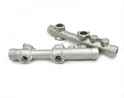

Ductile iron is a high-strength cast iron material developed in the 1950s. Its comprehensive performance is close to that of steel. Based on its excellent performance, it has been successfully used to cast some complex forces, strength, toughness, wear resistance. Parts with high performance requirements. Ductile iron has rapidly developed into a widely used cast iron material, second only to gray cast iron. The so-called "replacing steel with iron" mainly refers to ductile iron.
Ductile iron is obtained by spheroidization and inoculation treatment to obtain spheroidal graphite, which effectively improves the mechanical properties of cast iron, especially the plasticity and toughness, so that the strength is higher than that of carbon steel.
Main performance
Ductile iron castings are used in almost all major industrial sectors that require high strength, plasticity, toughness, wear resistance, resistance to severe thermal and mechanical shock, resistance to high or low temperatures, corrosion resistance, and dimensional stability. To meet these variations in service conditions, ductile iron is available in many grades, offering a wide range of mechanical and physical properties.
Most ductile iron castings, as specified by the International Organization for Standardization ISO1083, are mainly produced in an unalloyed state. Obviously, this range includes high-strength grades with a tensile strength greater than 800 N/mm² and an elongation of 2%. At the other extreme are the highly ductile grades with elongations greater than 17% and correspondingly lower strengths (minimum 370 N/mm2). Strength and elongation are not the basis for designers to select materials, and other decisive important properties include yield strength, elastic modulus, wear and fatigue strength, hardness and impact properties. Additionally, corrosion and oxidation resistance as well as electromagnetic properties may be critical to the designer. In order to meet these special uses, a group of austenitic ductile irons, usually called Ni-Resis ductile irons, have been developed. These austenitic ductile irons, mainly alloyed with nickel, chromium and manganese, are listed in international standards.
It is pearlitic ductile iron with medium and high strength, medium toughness and plasticity, high comprehensive performance, good wear resistance and vibration damping, and good casting process performance. Its properties can be changed by various heat treatments. Mainly used for various power machinery crankshafts, camshafts, connecting shafts, connecting rods, gears, clutch plates, hydraulic cylinders and other parts.