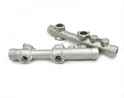

The shell, as the core molding carrier in investment casting, directly determines the quality of the casting and the stability of production. Especially when casting high-temperature alloys and stainless steel, it requires dual assurance through material optimization and process control. The following are key technical points:
Material selection is the basic guarantee. Refractory aggregates should prioritize materials with high melting points and low thermal expansion coefficients. The surface layer can use zircon sand, 99% pure white corundum, etc., with a temperature resistance of over 1800℃, capable of resisting direct erosion by molten metal; the backing layer uses cost-effective materials such as mullite and bauxite to balance strength and cost. The binder is mainly silica sol, and it is recommended to use graded nano-sized silica sol. Fine particles are used in the surface layer to improve density, and coarse particles are used in the backing layer to enhance thermal shock resistance. The addition of modifiers such as SKP-K1 can increase wet strength by 40%.

Shell-making process requires precise control. A multi-layer gradient coating process is used. The surface layer coating uses a 200-300 mesh fine-grained slurry, followed by sprinkling with 100-200 mesh fine sand after dipping to ensure a smooth surface; the backing layer uses an 80-150 mesh coarse-grained slurry to increase shell thickness and strength. The drying process requires maintaining a constant temperature and humidity environment of 20-25℃ and 40%-60% to avoid cracking caused by rapid drying. The drying time for each layer should be no less than 4 hours to ensure sufficient dehydration and polycondensation of the silica sol.
Firing treatment is a key strengthening step. After dewaxing, the shell needs to be fired at a high temperature of 850-1100℃ for 1-3 hours, gradually increasing the temperature to remove residual wax and organic matter, while improving the density of the shell. The firing curve should be smooth to avoid thermal stress caused by rapid cooling and heating, and the high-temperature holding stage ensures the structural stability of the shell. In addition, the porosity of the shell needs to be strictly controlled. Through particle size grading, the shell is both permeable and resistant to erosion. Preheating to 600-900℃ before pouring can further reduce the risk of thermal shock. Through material gradient matching, precise process control, and standardized firing treatment, the mold shell can stably withstand temperatures above 1500°C, effectively reducing defects such as cracking and erosion, and ensuring the accuracy and yield of the castings.