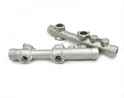

We are not unfamiliar with castings. The application of castings has a long history. In ancient times, people used castings to make coins, sacrificial weapons, tools and some living utensils. However, in modern times, castings are mainly used as blanks of machine parts or directly as machine parts. The proportion of castings in mechanical products is becoming more and more, the consumption is also increasing year by year, and the shape and variety of castings are also changing. Castings have gradually become an indispensable part of our daily life. The application of castings can be seen on various occasions such as door handles, door locks, small water pipes and so on.
Castings have excellent mechanical and physical properties. They can have various comprehensive properties of strength, hardness and toughness, and can also have one or more special properties, such as wear resistance, high temperature and low temperature resistance, corrosion resistance, etc.
The weight and size range of castings are very wide. The lightest weight is only a few grams, the heaviest can reach 400 tons, the thinnest wall thickness is only 0.5 mm, the thickest can exceed 1 meter, and the length can range from a few millimeters to more than ten meters, which can meet the use requirements of different industrial departments.
Compare the differences between castings and stainless steel forgings:
1. Castings have good wear resistance and shock absorption function. Because graphite in cast iron is conducive to lubrication and oil storage, it has good wear resistance. Similarly, due to the existence of graphite, the shock absorption of gray cast iron is better than that of steel.
2. The casting has good process performance. Due to its high carbon content and close to eutectic composition, gray cast iron has low melting point, good fluidity and small shrinkage, so it is suitable for casting castings with complex structure or thin wall. In addition, because graphite is easy to form chips during cutting, the machinability of gray cast iron is better than that of steel
3. The microstructure and mechanical properties of stainless steel can be improved after forging. After hot processing deformation by forging method, due to the deformation and recrystallization of stainless steel, the original coarse dendrite and columnar grain become equiaxed recrystallization structure with fine grain and uniform size, which makes the original segregation, porosity, porosity, slag inclusion and other compaction and welding in the ingot more compact, and improves the plasticity and mechanical properties of the metal.
4. The mechanical properties of castings are lower than those of forgings of the same material. However, forging can ensure the continuity of metal fiber structure, keep the fiber structure of forgings consistent with the shape of forgings, and ensure that parts have good mechanical properties and long service life. Forgings produced by precision die forging, cold extrusion, warm extrusion and other processes are unmatched by castings.
Both castings and stainless steel forgings are an indispensable part of mechanical production. In mechanical production, select the corresponding castings or forgings according to the different product performance. Only by giving full play to the role of castings or forgings can we have perfect mechanical products.