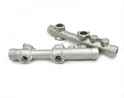

At present, the advantages and disadvantages of main shell making processes in domestic precision casting production are as follows:
1. At present, there are three kinds of shell making processes widely used in domestic precision casting production: A. water glass shell; B. Composite shell; C. Silica sol shell; D sodium silicate shell has a production history of nearly 50 years in China, and its plant number still accounts for a considerable proportion in China's precision casting manufacturers. Over the years, the strength of sodium silicate shell has doubled, and the surface quality, dimensional accuracy and yield of castings have been greatly improved by the improvement of back shell refractory and the popularization and application of new hardener. Low cost, shortest production cycle, excellent shelling performance and high air permeability are still inferior to any other shell forming process.
1.1 main problems
(1) The inherent disadvantage of sodium silicate binder is that the content of Na2O is high, and the high temperature strength and creep resistance of shell are far lower than that of silicon solvent shell. In addition, the surface refractory adopts quartz sand (powder) with low price, low quality and poor particle size grading, so it must not obtain high-quality precision castings.
(2) Shell production conditions are poor and lack of strict production process and parameter control. Due to the strong corrosivity of hardener, the dust removal equipment is simple, and few workshops have constant temperature, humidity and dust removal production environment. Coating preparation, hardening, air drying, dewaxing and other processes affecting the quality of mold shell and casting are rarely strictly controlled according to the operation specifications specified by the industry. The temperature, humidity and wind speed at the air drying part of the shell are not controlled, so batch scrapping quality accidents often occur in high, low temperature or plum rain seasons. In short, most factories stay in the manual workshop stage and produce by technology rather than scientific quality management. This is one of the important reasons for the unstable casting quality, high scrap rate and high repair rate of sodium silicate shell for decades.
2. At present, many factories use zircon powder, mullite powder and silica sol shell for the first and second layers of composite shell. The original water glass shell process shall still be used for the back layer. It is an improved scheme combining the excellent surface quality of silica sol shell and the advantages of low cost and short cycle of sodium silicate. Compared with sodium silicate shell, the surface quality of its castings has been greatly improved, the surface roughness, surface defects and repair rate have been reduced. The production cycle is similar to that of sodium silicate shell.
2.1 main problems
(1) Because the water glass binder is retained in the back layer, the overall high-temperature strength and creep resistance of the mold shell are lower than those of the silica sol mold shell, and the dimensional accuracy and geometric tolerance of the poured castings are lower than those of the silica sol mold shell.
(2) The air permeability is not as good as that of sodium silicate shell or silica sol shell. The high temperature strength of the shell is not as good as that of silica sol shell, which is easy to cause waste.
(3) The quality stability of composite shell casting is better than that of sodium silicate, but it is far worse than that of silica sol shell.
(4) Because the composite shell uses the expensive zircon powder as the surface layer, the shell cost is 4.5 times that of sodium silicate shell. If the back layer adopts mullite sand powder, the shell cost is almost the same as that of silica sol shell, and its advantage of low cost is not obvious.
(5) Medium temperature wax cannot be used for composite shell. Medium temperature wax cannot be dewaxed with hot water. When dewaxing in autoclave, due to high temperature and high pressure, the medium temperature wax liquid will have a violent saponification reaction with water glass and residual hardener in the back layer, so it can not be reused without recovery.
3. In the 1960s, as a ceramic shell binder, silica sol was used in the casting field. With its incomparable advantages, silica sol gradually replaced the widely used water glass and ethyl silicate hydrolysate with complex preparation process, pollution and high cost. Practice has proved that using silica sol solution as ceramic shell adhesive has the following advantages: simple preparation process, easy storage of coating, continuous use of dip coating slurry after adjusting its composition, reducing material consumption, stable dip coating process performance and easy operation, eliminating ammonia drying with ethyl silicate hydrolysate, improving working environment, and adopting hot air drying with controllable humidity, High shell strength, water-based silica sol, good safety. It is said that after changing from ethyl silicate to silica sol, the energy consumption is reduced by 20 ~ 30%, the shell qualification rate is increased by 15 ~ 20%, and the working environment is greatly improved.
3.1 silica sol (low-temperature wax) mold shell has easy low-temperature wax forming, simple equipment, little difference in wax mold surface roughness, and the process is more stable than the composite mold shell, especially the dimensional accuracy of the casting. Because it has no water glass, the mold shell has good high-temperature performance, high air permeability and strong creep resistance after roasting, it can be applied to both thin-walled parts and small and medium-sized parts with complex structure, It can also produce extra large pieces weighing 50 ~ 100kg.
3.1.1 existing problems
(1) Due to the use of low-temperature wax, most of the mold shells are dewaxed in water, so it is inevitable that saponification remains in the mold shell, which is easy to produce inclusions on the surface of the casting, and the repair rate is slightly higher.
(2) The long production cycle of shell making is its biggest disadvantage and deficiency. Especially in the production of large parts with deep holes and deep grooves, each layer is usually dried for 24 ~ 48h.
(3) The cost of silica sol shell (low temperature wax) is 5 times higher than that of sodium silicate shell and 17% higher than that of composite shell. The casting cost is relatively high.
3.2 silica sol (medium temperature wax) shell is an internationally used precision casting production process. It has the highest casting quality and the lowest repair rate. It is especially suitable for small and medium-sized parts with high surface roughness requirements and high dimensional accuracy.
3.2.1 existing problems
(1) The cost is high, and the production cost of its shell is 8 times that of sodium silicate shell. It is also 25% higher than that of low temperature wax silica sol shell.
(2) The production cycle is the same as that of low-temperature wax silica gel sol shell, which is much longer than that of sodium silicate and composite shell.
(3) Medium temperature liquid wax and high pressure wax injection are often used in the production of medium and large parts. The thick wall wax mold is easy to shrink and concave, and the dimensional accuracy of the casting is not too high. The requirements for dimensional accuracy and surface roughness of medium and large parts are not as high as those of small parts, so silica sol (medium temperature wax) shell is rarely used for medium and large parts.