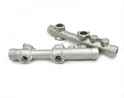

As a supplier of What Is Investment Casting, I'm often asked about the intricacies of the investment casting process, especially the drying process for the investment casting shell. In this blog post, I'll delve into the details of this crucial step, explaining its significance, the methods involved, and the factors that influence it.
The Significance of the Drying Process
The investment casting shell is a critical component of the investment casting process. It is created by repeatedly dipping a wax pattern into a ceramic slurry and then coating it with a refractory material. Once the shell has reached the desired thickness, it must be dried to remove the moisture and strengthen the ceramic structure. The drying process is essential for several reasons:
- Strength and Integrity: Proper drying ensures that the shell has the necessary strength and integrity to withstand the high temperatures and pressures of the casting process. If the shell is not dried adequately, it may crack or break during casting, leading to defective parts.
- Dimensional Accuracy: Drying helps to stabilize the dimensions of the shell, reducing the risk of shrinkage or distortion during casting. This is particularly important for parts with tight tolerances.
- Surface Finish: A well-dried shell can contribute to a smoother surface finish on the final cast part. Moisture trapped in the shell can cause defects such as porosity or rough surfaces.
Methods of Drying the Investment Casting Shell
There are several methods used to dry the investment casting shell, each with its own advantages and disadvantages. The choice of method depends on factors such as the size and complexity of the shell, the type of ceramic materials used, and the production requirements.


Air Drying
Air drying is the simplest and most commonly used method for drying investment casting shells. In this method, the shells are placed in a well-ventilated area at room temperature or slightly elevated temperatures. The moisture in the shell evaporates slowly over time, allowing the ceramic structure to solidify.
- Advantages: Air drying is a cost-effective method that requires minimal equipment. It is suitable for small to medium-sized shells and can be easily integrated into the production process.
- Disadvantages: Air drying is a relatively slow process, which can limit production throughput. It also requires careful control of the drying environment to prevent uneven drying or the formation of cracks.
Forced Air Drying
Forced air drying involves using fans or blowers to circulate air around the shells, accelerating the evaporation of moisture. This method can significantly reduce the drying time compared to air drying.
- Advantages: Forced air drying is faster than air drying, allowing for higher production rates. It can also help to ensure more uniform drying, reducing the risk of cracking.
- Disadvantages: Forced air drying requires additional equipment and energy, which can increase costs. It may also cause the surface of the shell to dry too quickly, leading to the formation of a hard crust that can trap moisture inside.
Oven Drying
Oven drying involves placing the shells in an oven at a controlled temperature to remove moisture. This method provides precise control over the drying process and can be used for large or complex shells.
- Advantages: Oven drying allows for faster and more consistent drying compared to air or forced air drying. It can also be used to dry shells made from materials that require higher temperatures for proper curing.
- Disadvantages: Oven drying requires specialized equipment and energy, which can be expensive. It also requires careful monitoring of the temperature and time to prevent overheating or damage to the shells.
Factors Affecting the Drying Process
Several factors can influence the drying process for the investment casting shell, including:
- Shell Thickness: Thicker shells take longer to dry than thinner shells. The drying time may need to be adjusted accordingly to ensure that the entire shell is properly dried.
- Ceramic Materials: Different ceramic materials have different drying characteristics. Some materials may dry more quickly or require higher temperatures for proper curing.
- Humidity and Temperature: The humidity and temperature of the drying environment can significantly affect the drying rate. High humidity can slow down the evaporation of moisture, while low humidity can cause the shell to dry too quickly and crack.
- Ventilation: Proper ventilation is essential for removing moisture from the drying area. Poor ventilation can lead to the accumulation of moisture, which can prolong the drying time and increase the risk of defects.
Quality Control in the Drying Process
To ensure the quality of the investment casting shell, it is important to implement a comprehensive quality control program during the drying process. This may include:
- Monitoring Drying Time and Temperature: Regularly monitoring the drying time and temperature can help to ensure that the shells are being dried properly. Deviations from the recommended drying parameters should be investigated and corrected.
- Inspecting Shells for Defects: Visual inspection of the shells before and after drying can help to identify any defects such as cracks, warping, or uneven drying. Defective shells should be rejected or reworked as necessary.
- Testing Shell Strength: Periodically testing the strength of the dried shells can help to ensure that they have the necessary integrity to withstand the casting process. This can be done using non-destructive testing methods such as ultrasonic testing or destructive testing methods such as compression testing.
Conclusion
The drying process for the investment casting shell is a critical step in the investment casting process. It plays a crucial role in ensuring the strength, integrity, dimensional accuracy, and surface finish of the final cast part. By understanding the significance of the drying process, the methods involved, and the factors that influence it, manufacturers can optimize the drying process to produce high-quality investment casting shells.
If you are interested in learning more about investment casting or are looking for a reliable supplier of Investment Casting Supplies, please feel free to contact us. We have extensive experience in the investment casting industry and can provide you with the highest quality products and services. Whether you need assistance with the Investment Casting Process or have questions about What Is Investment Casting, our team of experts is here to help. We look forward to discussing your specific requirements and finding the best solutions for your investment casting needs.
References
- Campbell, J. (2008). Castings. Butterworth-Heinemann.
- Whelan, M. J., & DeBarbadillo, M. A. (2010). Modeling and simulation of investment casting processes. John Wiley & Sons.
- Flemings, M. C. (1974). Solidification processing. McGraw-Hill.