


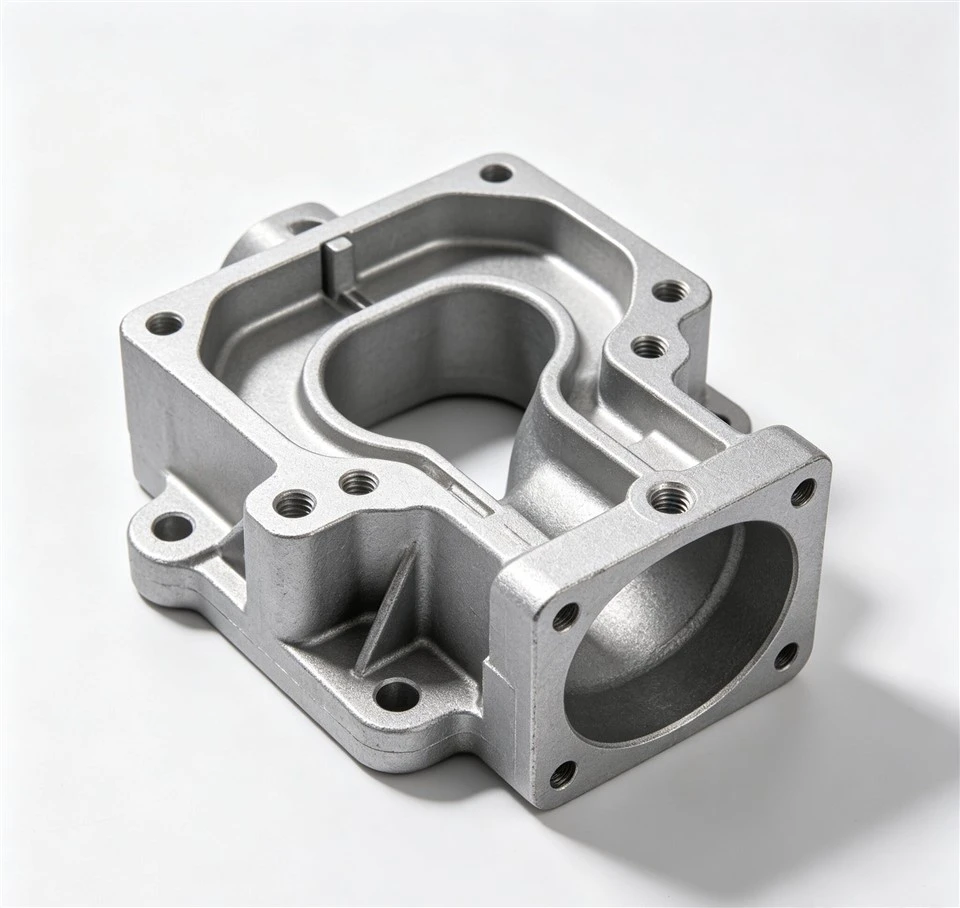
Custom Lost Foam Casting (also designated as Evaporative Pattern Casting or EPC) is a near-net-shape manufacturing technology engineered for complex, highly integrated metal components. By utilizing expanded polystyrene (EPS) or polymethyl methacrylate (PMMA) foam patterns embedded in un-bonded silica sand, the process eliminates traditional internal sand cores, mold parting lines, and draft angles.
During pouring, molten metal vaporizes the polymer pattern on contact, replicating the exact geometry with zero draft requirement and minimal internal flash. This enables the consolidation of multi-piece assemblies (such as bolted or welded valve bodies, engine blocks, and pump casings) into a single monolithic casting, reducing secondary machining allowances down to 1.0 mm – 2.5 mm.
Manufacturing Process
The Lost Foam Casting production sequence at Wabon Metals integrates automated pattern tooling with controlled thermal pouring:
Foam Pattern Tooling & Molding: Pre-expanded EPS or PMMA beads are injected into heated aluminum molds using automated shape molding machines. Pattern density is maintained between 0.020 g/cm³ and 0.026 g/cm³ to balance dimensional stability against carbon residue during thermal decomposition.
Cluster Assembly & Gating: Pattern segments and internal fluid channels are joined using hot-melt adhesive assembly fixtures. Runner, riser, and sprue systems are integrated directly onto the cluster.
Refractory Coating Application: Assembled clusters are dipped into a water-based refractory coating (silica/mullite slurry) and dried under temperature and humidity-controlled environments (35°C, relative humidity under 40%). The coating establishes a permeable shell (0.5 mm – 1.0 mm thickness) that supports the sand mold wall while enabling pyrolytic gas escaping.
Vibratory Flask Compaction: The dried cluster is positioned in a flask surrounded by dry, binderless silica sand. Tri-axial vibration tables compact the sand around intricate internal cavities at frequencies of 40 Hz to 60 Hz.
Thermal Pouring & Vaporization: Molten alloy is introduced into the sprue. The heat (pouring temperature of 1380°C to 1450°C for iron; 1520°C to 1580°C for steel) instantly pyrolyzes the pattern (EPS converts to gas and liquid residue), with molten metal occupying the cavity in a 1:1 volumetric replacement. Vacuum assistance (-0.03 MPa to -0.05 MPa) is applied to evacuate pyrolysis gases.
Shakeout, Shot Blasting & Heat Treatment: Unbound sand flows freely during shakeout without mechanical knock-out hammers. Castings undergo steel shot blasting (Sa 2.5) followed by normalizing, annealing, or quenching & tempering as required by material grade.
Materials and Technical Specifications
Alloy Capability Matrix
|
Material Category |
Standard Grades |
Mechanical Properties |
Key Applications |
|
Ductile Iron (Nodular Iron) |
ASTM A536 65-45-12, 80-55-06, 100-70-03 EN-GJS-400-15, EN-GJS-500-7 |
Tensile: 415–700 MPa Yield: 275–480 MPa Elongation: 3–18% |
Axle housings, control arms, hydraulic valve blocks, gearboxes. |
|
Gray Cast Iron |
ASTM A48 Class 30, Class 35, Class 40 EN-GJL-250, EN-GJL-300 |
Tensile: 200–350 MPa Hardness: 170–260 HBW |
Engine blocks, cylinder heads, brake drums, compressor housings. |
|
Carbon Steel |
ASTM A27 Grade 65-35, ASTM A216 WCB/WCC |
Tensile: 450–580 MPa Yield: 240–315 MPa |
Heavy equipment brackets, structural mounts, valve bodies. |
|
Alloy & Stainless Steel |
ASTM A351 CF8, CF8M (304 / 316) ASTM A148 80-50, 90-60 |
Tensile: 485–650 MPa Corrosion Resistance: High |
Marine hardware, chemical process pump impellers, turbine housings. |
|
Aluminum Alloys |
A356.0-T6, A380.0, AlSi7Mg |
Tensile: 220–310 MPa Density: 2.68 g/cm³ |
Automotive intake manifolds, heat sinks, structural brackets. |
Process Parameters & Tolerance Standards
|
Parameter |
Lost Foam Specification Standard |
Comparison / Notes |
|
Dimensional Tolerance |
ISO 8062-3 DCTG 6 to DCTG 8 (CT6–CT8) |
Tighter than Sand Casting (CT9–CT11); approaches Investment Casting (CT4–CT6). |
|
Linear Shrinkage Allowance |
0.8% – 1.5% (alloy-dependent) |
Pattern tooling scaled in CAD based on solidification modeling. |
|
Surface Roughness (Ra) |
Ra 6.3 µm – 12.5 µm (Standard) Ra 3.2 µm (with PMMA & fine coating) |
Eliminates grinding on unmachined structural surfaces. |
|
Minimum Wall Thickness |
3.0 mm (Ductile Iron / Steel); 2.5 mm (Aluminum) |
Prevents premature misruns during foam decomposition. |
|
Machining Allowance |
1.0 mm – 2.0 mm |
Saves 40%–60% raw material removal compared to sand casting (3–6 mm). |
Key Product Features
Zero Draft Angle Requirement:
Allows parallel vertical walls and complex internal channels without draft taper, saving weight and machining time.
Monolithic Component Integration:
Internal passageways, oil lines, mounting flanges, and stiffening ribs can be molded as a single unit, eliminating assembly hardware and gasket seal joints.
No Mold Parting Lines or Core Print Flash:
Because the sand is binderless and surrounds a single foam cluster, casting seam flash is eliminated, reducing fettling and manual grinding costs by up to 70%.
High Dimensional Consistency Across Batches:
CNC-machined aluminum pattern tooling ensures repeatable pattern geometry within ±0.2 mm for critical mounting centers.
Typical Applications
Industry Footprint: Engineered for high-complexity, medium-to-high volume industrial components requiring pressure tightness, internal fluid routing, or structural weight optimization.
Fluid Handling & Hydraulics: Multi-way valve bodies, high-pressure pump casings, centrifugal impellers, hydraulic manifold blocks (internal oil channels molded without core drilling).
Automotive & Commercial Vehicles: Engine cylinder blocks, transmission housings, exhaust manifolds, axle steering knuckles, brake calipers.
Agricultural & Construction Machinery: Planetary gear carriers, tractor lift arms, suspension brackets, track roller frames.
Power Generation & Energy: Wind turbine hub components, gearbox housings, compressor bodies, burner nozzles.
Machining and Secondary Operations
To deliver fully finished, drop-in assembly components, Wabon Metals operates an in-house machine shop and finishing facility:
CNC Machining:
4-axis and 5-axis horizontal machining centers (HMC), vertical machining centers (VMC), and CNC turning centers. Position accuracy: ±0.005 mm.
Heat Treatment:
Computer-controlled electrical furnaces for Annealing, Normalizing, Quenching & Tempering (Q&T), Solution & Aging (T6 for Aluminum), and Stress Relieving.
Surface Finishing:
Automated steel shot blasting, zinc electroplating, manganese phosphating, epoxy powder coating, and wet spray painting (up to C5 corrosive environment standards).
Quality Control and Inspection
Quality assurance is integrated into every step, supported by our ISO 9001:2015 and IATF 16949 quality management system:
|
Inspection Type |
Equipment / Method |
Evaluation Standard / Capability |
|
Chemical Composition |
Optical Emission Spectrometer (OES) |
100% heat-by-heat chemical composition verification prior to pouring. |
|
Dimensional Inspection |
3D Coordinate Measuring Machine (CMM), 3D Laser Scanner |
CMM accuracy to 1.8 µm + L/300. Full GD&T inspection report provided. |
|
Internal Integrity (NDT) |
X-ray Radiography, Ultrasonic Testing (UT), Magnetic Particle (MT) |
Detects gas porosity, carbon inclusion, or shrinkage cavities per ASTM E446 / E186. |
|
Mechanical Testing |
Universal Tensile Tester, Brinell/Rockwell Hardness, Charpy V-Notch Impact |
Yield, tensile, elongation, and impact energy verification at room and sub-zero temperatures. |
|
Pressure Leak Testing |
Hydrostatic & Pneumatic Air-Underwater Testing |
100% testing on pressure-retaining valve bodies and pump casings up to 30 bar. |
OEM and Custom Manufacturing
We support full OEM/ODM product lifecycle development, from prototype pattern carving to mass production tooling:
Prototyping & Low-Volume Validation: Direct CNC machining of solid EPS/PMMA foam blocks. Eliminates hard aluminum tooling costs for 1–20 piece functional prototype testing. Lead time: 10–15 days.
DFM & Casting Simulation: MAGMASOFT® / ProCAST solidification analysis to identify potential shrinkage porosity, cold shuts, or foam burnout gas entrapment before tool cutting.
Mass Production Tooling: High-durability multi-cavity aluminum tooling with automated ejector systems, designed for 100,000+ injection cycles. Lead time: 25–35 days.
What Buyers Should Provide for an RFQ
To receive an accurate engineering quotation within 24–48 hours, please include:
3D CAD Models:
STEP (.stp), IGES (.igs), or SolidWorks (.sldprt) files.
2D Engineering Drawings:
PDF with machining tolerances, surface finish (Ra), and critical GD&T specifications.
Material Specification:
Grade standard (e.g., ASTM A536 65-45-12, EN-GJS-500-7) or chemical/mechanical targets.
Production Volume:
Annual estimated order quantity (EAU) and batch delivery sizes.
Scope of Supply:
As-cast, rough machined, fully CNC finished, heat treated, or surface coated.
Inspection Requirements:
Mandatory NDT (X-ray, UT, MT), CMM reports, 3.1 material certificates per EN 10204.
Frequently Asked Questions
Q: How does Lost Foam Casting compare to Investment Casting (Lost Wax) in cost and precision?
A: Lost Foam offers comparable geometric freedom and near-net shape accuracy (CT6–CT8) at a lower unit cost for medium-to-large components. Lost foam eliminates multi-stage ceramic shell dipping and autoclave dewaxing. However, investment casting achieves slightly finer surface finish (Ra 1.6–3.2 µm vs Ra 6.3 µm) and is better suited for thin-walled small parts (under 2 mm).
Q: How do you prevent carbon defects and gas porosity during foam vaporization?
A: We mitigate carbon defects by controlling pattern density (under 0.022 g/cm³), using PMMA-blended foam for low-carbon steel alloys, applying high-permeability refractory coatings, and utilizing vacuum-assisted pouring (-0.04 MPa) to rapidly extract pyrolysis gases before metal solidification.
Q: What is the typical MOQ for custom tooling production?
A: Our production MOQ is flexible depending on component size. For small-to-medium castings (1–10 kg), MOQ starts at 500 units per production run. For large castings (over 50 kg), MOQ starts at 50–100 units. Prototype orders using CNC-machined foam require an MOQ of just 1 piece.


